Why Cloud Infrastructure Management Must Address Cost and Risk Together (FinSec)
Cloud cost and security are inherently intertwined by design, but seldom evaluated together. The most effective cloud infrastructure management strategy uses cost efficiencies to directly fund security improvements.
Key takeaways
- Managing cloud spend and security separately creates unnecessary silos - different teams, different budgets, different goals.
- Cloud cost and security are financially and operationally linked. Leaders who act on this significantly reduce overall risk without increasing total cloud spend.
- Prioritizing cloud finance+security posture, a concept we call FinSec, is the most pressing issue SMB leaders need to focus on.
- Cost-security design principles aren’t complicated, but implementing them requires a FinSec lens.
Cloud Costs vs. Security
Cloud cost and cloud security are often treated as opposing forces, but in practice they are tightly coupled outcomes of the same system. When cloud infrastructure management addresses cost and risk together, improvements compound. When separated, inefficiency and exposure grow side by side.
I’ve seen this pattern repeatedly: the teams responsible for cost optimization and those responsible for security posture work at cross-purposes. They're in different meetings, with different owners, working from different budgets, and sometimes even with different definitions of success—all while operating on the same cloud environment.
This disconnect is usually built in. Most organizations are implicitly taught to separate cost optimization from security, where one side is measured on savings, the other on risk reduction (which usually increases costs). The result is a false tradeoff that misrepresents how cloud infrastructure actually works.
Cost and risk in the cloud aren’t independent variables, but rather they’re two signals emitted by the same underlying decisions.
Different Disciplines, Same Problems in Cloud Infrastructure Management
Frameworks like FinOps and SecOps solve real problems, but they solve them in isolation. FinOps introduces financial accountability while SecOps introduces controls and compliance. Neither fully addresses how infrastructure decisions simultaneously shape spend and exposure.
Every architectural choice has a financial footprint and a security consequence. Overprovisioning increases cost and expands attack surface. Excessive public access drives egress spend and risk. Idle resources inflate bills while remaining exploitable.
The misconception I encounter most often is that improving security means increasing spend. Sometimes it does. But many of the most effective security improvements come from removing things that shouldn’t exist in the first place.
Decommissioning unused resources (and automating this process) saves money and reduces exposure. Restricting access can reduce egress costs and limits blast radius. Network design choices affect both data transfer spend and threat models. These changes aren’t flashy, but they scale with your environment.
Why Lean Infrastructure Teams Deprioritize Security
It all comes down to budget and resources. The tension between cloud spend and security exists in every organization, but lean teams tend to focus on the cost aspects of their infrastructure.
When teams are small, responsibility collapses. The same engineers are accountable for infrastructure reliability, cost discipline, delivery velocity, and security hygiene. Budgets are finite, headcount is fixed, and there is little operational slack. As a result, missteps compound quickly. A poorly designed infrastructure drives unexpected spend. Idle resources expand the attack surface. Architectural shortcuts taken to move faster create long-term cost and security drag.
Unlike larger organizations, lean teams can’t mask these inefficiencies. Enterprises may operate with disconnected infrastructure, cost, and security decisions for years because scale and budget mask the impact. They can also invest in tools that allow them to mitigate their exposure instead of fixing it. Lean teams don’t have these buffers.
This is where the tradeoffs emerge.
Failed audits stall growth. Security gaps force reactive tooling purchases that further strain budgets. Security measures are approved without addressing the underlying architectural inefficiencies driving cost. Cost optimization decisions are made without understanding their security implications. Security priorities are delayed due to budget constraints. Everyone is acting within their lane, but each decision in isolation, increases both spend and risk.
For lean teams, treating cost, security, and cloud infrastructure management as separate concerns breaks down fast… and compounds over time.
Push Cost and Security Left
The ideal way to properly address all security and cost decisions is to push them left, all the way to the design phase.
When a team is initially designing an infrastructure/solution, they should take all the aforementioned downstream security issues into account. The reality, however, is that this rarely happens. Between deadlines, clients to support, growth, staff changes, and other shifting priorities, most companies end up with infrastructure that doesn’t properly balance cost efficiency and security. So they react.
An alternative perspective I propose is to focus on how cloud financial savings can be reinvested into security, a strategy I call FinSec.
What is FinSec?
FinSec is a leadership strategy that focuses on converting cloud infrastructure inefficiencies into capital for security. It’s a business-focused approach that aligns cloud finance+security, FinSec for short.
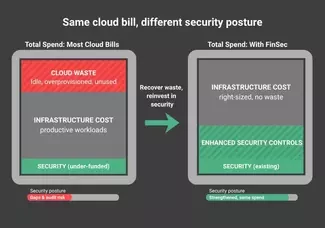
FinSec targets cloud waste to recover budget, which is then explicitly reinvested into strengthening security posture.
Why FinSec works:
- It solves the "cheaper is less secure" issue by distinguishing between "cutting corners" (bad) and "removing inefficiency" (good).
- It frames the cost cut as a means to an end (funding security).
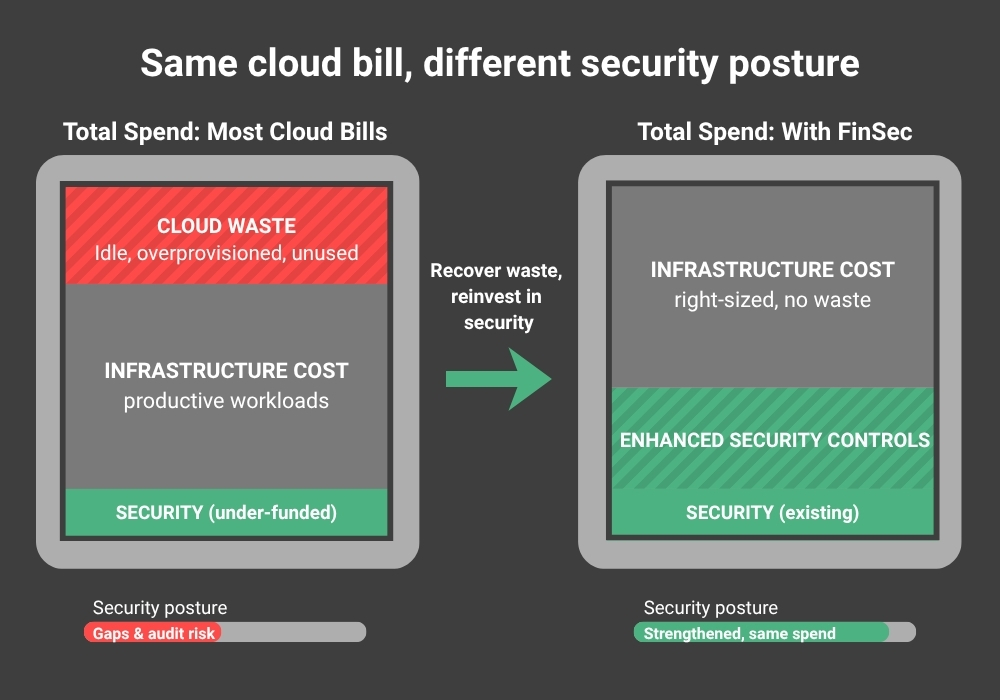
After seeing teams across companies and industries struggle to invest needed resources into security (which they all admitted was a priority), it became clear that the problem needed to be reframed.
Cloud financial efficiency and cloud security posture are part of the same system. Managing them separately forces teams to compete for budget and attention. Managing them together allows improvements in one area to reinforce the other.
That relationship between cloud finances and security is what I’m calling FinSec. By simply naming cloud finance+security FinSec, I tie the two concepts together. And because what you name gets prioritized. When they’re named and evaluated together, they become part of the same strategic conversation.
FinSec isn’t a product, a framework, or a market category. It’s a leadership lens for cloud infrastructure management, which focuses on addressing cost and risk together. It reframes how cloud (in)efficiencies and security interact when resources are constrained.
The Principles That Shape FinSec
These concepts form the backbone of FinSec. These aren’t revolutionary ideas, but combined have a significant impact on overall cloud cost and security posture.
- Efficiency–Security Duality
Efficiency and security are two sides of the same operational discipline. Anything unused, overprivileged, or unmonitored is both wasted spend and potential unnecessary exposure.
- The Inverse Cost–Security Curve
Unmanaged growth pushes cost and risk upward together. Disciplined cloud infrastructure management bends that curve by eliminating inefficiency and redirecting savings toward higher-impact security improvements.
- Risk-Weighted Cloud Decisions
Not all cloud problems are equal. Prioritization should be driven by combined financial exposure and security impact, especially when engineering resources are limited.
- Operational Compression
Overhead matters. Treating cost, infrastructure, and security as separate workflows increases coordination tax. Treating them as one system reduces it.
- Reinvesting Savings into Security as a Strategic Win
Success for most teams isn’t perfect security or minimum spend. It’s about creating a balance that meaningfully improves security posture without increasing total cloud spend.
Address Cloud Finances + Security Early with a Break-Even Target
As cloud environments scale, the relationship between cost and risk tightens. Security tooling often scales with infrastructure: logging, monitoring, and controls can become more expensive as environments grow. When cloud infrastructure management lacks discipline, security appears costly—not because it inherently is, but because inefficiency amplifies its price.
The result is that teams end up paying for past infrastructure decisions that make security harder and more expensive than it needs to be.
This dynamic is reinforced by organizational structure. Infrastructure teams are measured on reliability and delivery. Security teams are measured on risk reduction. Finance teams are measured on predictability. Each group is optimizing locally inside the same system, which leads to friction rather than coordination.
Without a shared objective, cost optimization and security improvement compete for resources and attention.
A reinvestment strategy with a break-even target changes that dynamic. When leaders proactively decide that cloud efficiency savings are measured and reinvested into risk reduction, security stops being a political budget request and becomes an operational outcome of good cloud infrastructure management.
FinSec as a Leadership Framework
FinSec isn’t about dashboards or tools. It’s about how cloud infrastructure decisions are evaluated and approved.
Leaders need to stop approving (or delaying) cost and security initiatives separately and start asking teams to model tradeoffs across the full system. Progress should be measured in cumulative savings that fund cumulative risk reduction.
Steps to Implementing a FinSec Strategy
- Create shared visibility across cloud cost and security
Ensure cloud resources are viewed through a single lens that shows both spend and security posture together, not in separate tools or reviews.
- Reduce costs
- Eliminate infrastructure that adds cost without reducing risk - remove idle, overprovisioned, or unnecessary resources automatically.
- Implement an optimal commitment strategy - purchase or adjust reservations and savings plans based on your usage.
- Quantify savings that can fund security
Focus on durable, month-over-month savings that can reliably support ongoing security controls.
- Understand what cloud-native security actually costs at scale
Account for the real, usage-based cost of logging, monitoring, detection, and compliance as infrastructure grows.
- Reinvest savings into the highest combined risk reduction
Direct recovered budget toward security improvements that meaningfully improve security compliance and reduce breach likelihood. Know what it costs to implement each additional security measure.
- Operationalize FinSec as a continuous loop
Review cost and security together on a regular cadence so infrastructure decisions reinforce both outcomes over time. Ask your teams:- Cost-focused: How have cloud costs changed month-to-month? What are the top 5 services driving costs? Which cloud cost reduction strategies have been implemented and how much did they save?
- Security-focused: How have compliance scores changed month-to-month? Which remediation actions had the biggest impact on compliance and what did they cost to implement?
- Infra-focused: This is not an exhaustive list of cost reduction tactics, but rather a limited checklist of quick wins for teams wanting to move the needle quickly, say within a quarter.
- Cost-focused: How have cloud costs changed month-to-month? What are the top 5 services driving costs? Which cloud cost reduction strategies have been implemented and how much did they save?
The Strategic Takeaway
The teams that win with a cost-efficient, secure cloud infrastructure will be the ones who understand how cost and risk support each other. Leaders with effective teams will be the ones who structure workflows, objectives, and cloud infrastructure management strategy accordingly.
FinSec is about understanding the math between risk, spend, and growth, and leading with that focus.
AI Tool for FinSec
Kalos AI delivers the insights and automations lean teams need to cut costs fasts and reinvest savings into effective security controls. Try Kalos free and discover how you can optimize your AWS environment →
FAQs
FinSec is a leadership approach that treats cloud cost and cloud security as two outcomes of the same set of decisions. The idea is to identify financial waste in your cloud environment, capture those savings, and then redirect that recovered budget into security improvements. This reframes cloud infrastructure management as a single coordinated practice rather than two competing budget lines, which means a stronger security posture often costs you nothing extra in net spend.
Most organizations have different teams, different budgets, and different success metrics for cost and security work. Finance owners optimize for predictability, infrastructure teams optimize for reliability and delivery, and security teams optimize for risk reduction. Each group is doing the right thing inside its own lane, but the result is that decisions get made in isolation. Lean teams feel this most acutely because they do not have the headcount or tooling budget to mask the inefficiency that builds up between those silos.
A surprising amount of security exposure comes from things that should not exist anymore, such as idle EC2 instances, unattached EBS volumes, overly broad IAM roles, and resources nobody owns. Removing those reduces your attack surface and your monthly bill in the same step. Tightening egress paths, decommissioning unused workloads, and right sizing overprovisioned services all do the same thing. You are not cutting corners on security, you are removing the inefficiency that was creating exposure in the first place.
The strategy rests on five ideas. Efficiency and security are two sides of the same operational discipline, so anything unused or overprivileged is both wasted spend and unnecessary risk. Unmanaged growth pushes cost and risk upward together, so disciplined practice bends that curve. Prioritization should be driven by combined financial and security impact rather than either one alone. Treating cost, infrastructure, and security as one system reduces coordination overhead. Reinvesting savings into higher impact security improvements creates a measurable break even target instead of a political budget fight.
Kalos is built specifically for small and midsize teams running on AWS, and it puts cost insight and security posture in the same view. The platform identifies cost optimization opportunities, surfaces misconfigurations and compliance gaps, and uses AI to recommend remediations that you can apply with a single click. Because savings and risk are visible together, leadership can see exactly how much waste was recovered and how that budget was reinvested into security work, which is the practical loop FinSec is built around.
Let us create a plan to cut costs and improve security in your AWS environment.
Get in touch for a free analysis.